Our History
What is today Nigeria has been home to successive peoples and states for many centuries. Early inhabitants of parts of the region included the Nok culture (about 500 B.C. to A.D. 200). Later migrations and kingdoms involved communities such as the Kanuri, Hausa, and Fulani. Islam reached parts of the north from the thirteenth century through contacts across the Sahara. The Kanem empire influenced the area from the late eleventh to the fourteenth century. From the early nineteenth century, Fulani-led emirates were important political forces in the north.
Trade, coast, and colonial rule
The modern name “Nigeria” draws on the River Niger, Africa’s second longest river, and on the peoples living along the Niger and its tributary, the Benue. From the late fifteenth century, Europeans arriving from the south visited the Bights of Benin and Bonny in search of tropical products and, for a time, enslaved people. In the eighteenth century, ports such as Lagos, Brass, Bonny, and Old Calabar were major centres of the trans-Atlantic slave trade, with inland routes linking southern communities to the Hausa states. As that trade declined, interest grew in palm oil and other legitimate commerce.
In 1849 the British Government appointed John Beecroft as consul for the Bights of Benin and Bonny. In 1861 Lagos was proclaimed a Crown Colony. In the north, several British trading interests were brought together under Sir George Taubman Goldie from 1879; in 1899 the British Government took over that administration. In 1914 the northern and southern British administrations were amalgamated into a single territory known as Nigeria.
Independence and the First Republic
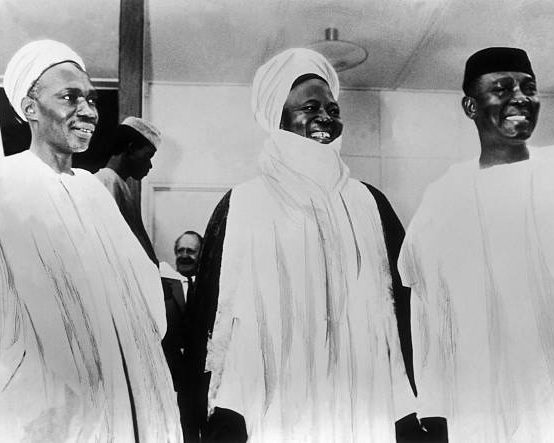
British colonial administration continued until 1 October 1960, when Nigeria gained independence. The country became a republic on 1 October 1963, with Lagos as the capital. Nigeria joined the Commonwealth and the United Nations. The first independent government was formed by a coalition of northern and eastern political parties, with Nnamdi Azikiwe as President and Abubakar Tafawa Balewa as Prime Minister. Organised as a loose federation of self-governing regions, the new nation faced the task of uniting a country with about 250 ethnic and linguistic groups.
Military rule, civil war, and return to civilian leadership
Political tension and unrest, especially in the Western Region, preceded the seizure of power by the armed forces in January 1966. Major-General Aguiyi Ironsi headed the federal military government and suspended the republican constitution. After further upheaval in 1966, Lt. Col. Yakubu Gowon assumed leadership and restored a federal framework.
Violence against Igbo communities in the north drove many eastward. On 30 May 1967 the eastern region declared independence as the Republic of Biafra, and civil war followed. In January 1970, after about 31 months of conflict, Biafra surrendered. Gowon reorganised the four regions into twelve states.
In 1975 a bloodless coup brought Brigadier Murtala Rufai Mohammed to power. He set a timetable for return to civilian rule and increased the number of states from twelve to nineteen. After his assassination in an abortive coup in February 1976, General Olusegun Obasanjo continued the transition. Civilian rule returned with the election of Alhaji Shehu Shagari as President in 1979. An oil boom in the 1970s strongly shaped the economy of that era.
Christianity in Nigeria
Christian presence along the coast dates to the fifteenth century, when Portuguese Augustinian and Capuchin monks arrived. Sustained Anglican mission work began later; the first Church of England mission in the area was established at Badagry in 1842 by Henry Townsend. Indigenous religions were practised across the region before the wider spread of Islam and Christianity, both of which many communities came to embrace over time.